How do I help my students feel confident in math from day one?

One of my biggest goals as a classroom teacher wasn't just helping students learn math. It was helping them see themselves as math people.
The first weeks of school set the stage for how kids see themselves as mathematicians. By creating early math experiences where every child can succeed, we send a clear message from day one: you belong here, and you can do this.
Jo Boaler's work on mathematical mindsets reminds us that students develop confidence when they have opportunities to notice patterns, explore ideas, and make sense of mathematics, not simply memorize procedures.¹
The good news is that you don't need to redesign your math block to create those experiences. A few simple routines can make a big difference. Here are three that I come back to every August.
Begin with a math hook
One of my favorite ways to start a lesson is with a Notice & Wonder.
Before I explain the learning target or model a strategy, I project a visual representation of the mathematical idea– in this case, the first level of Struggly’s multi-digit subtraction task “Saddle up Subtraction”-- and ask two simple questions:
What do you notice?
What do you wonder?
That's it.
The best thing about Notice & Wonder is that everyone can participate. Even students who are usually hesitant to share speak up because there's no way to be wrong (although, there's nothing wrong with being wrong when we can learn from it! But more on this later...). Students are simply sharing what they notice and wonder. It also gives students the opportunity to hear how their classmates think and see creativity modeled by their peers. Instead of simply hearing the teacher say, "Everyone's ideas are valuable," they experience it firsthand as they listen to the rich thinking unfolding around the room.
The second best thing about Notice & Wonder is how little prep it requires. Have a compelling visual ready, ask students what they notice and wonder, and let the magic unfold. If you're looking for a place to start, open tomorrow's lesson with Saddle Up Subtraction (or another Struggly task that connects to your learning goal) and simply ask, What do you notice? What do you wonder?
Make time for visual exploration
Another routine I come back to is giving students time to explore mathematics visually before we talk about procedures. Even ten minutes of visual exploration before direct instruction gives students’ brains something to grab onto and connect new learning to.
Take multiplication, for example.
Before asking students to memorize that 4 × 3 = 12, give them a chance to see why it's true by exploring multiple representations (ex. Three groups of four items) and making connections to past ideas (ex. 3+3+3+3=12, where’s the 4?).
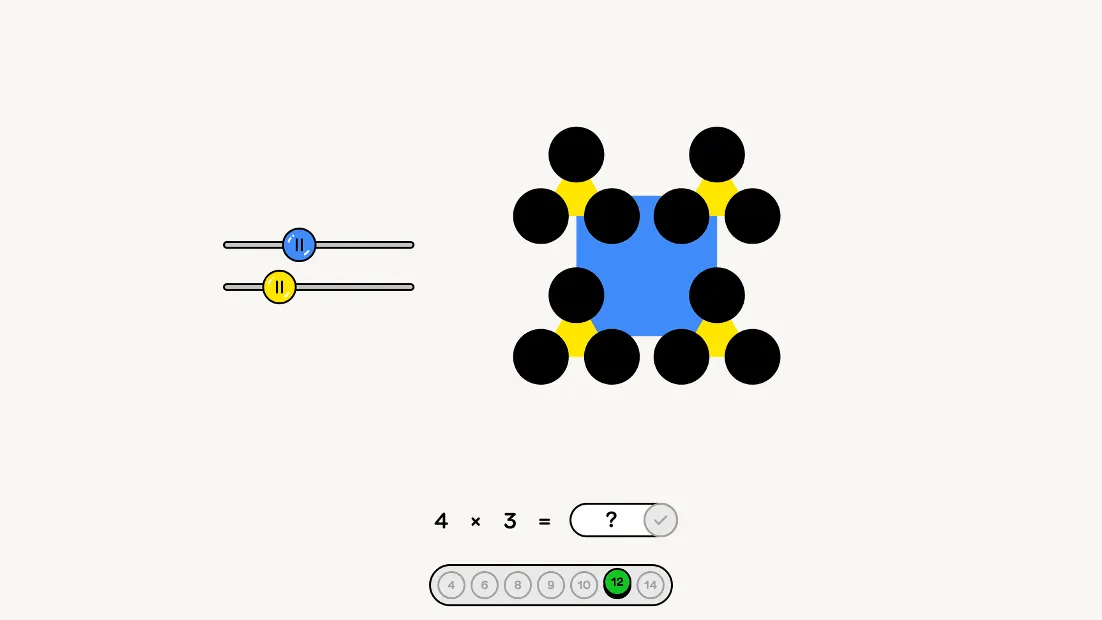
Hall of Mirrors, is a great example of a visual task that allows students to explore these connections. Students move sliders and watch the groups change. One student sees four groups of three (see image above). Another notices it's the same as 3 + 3 + 3 + 3. Someone else realizes that switching the sliders in the other order shows four groups of three (see image below) or 4 + 4 + 4.
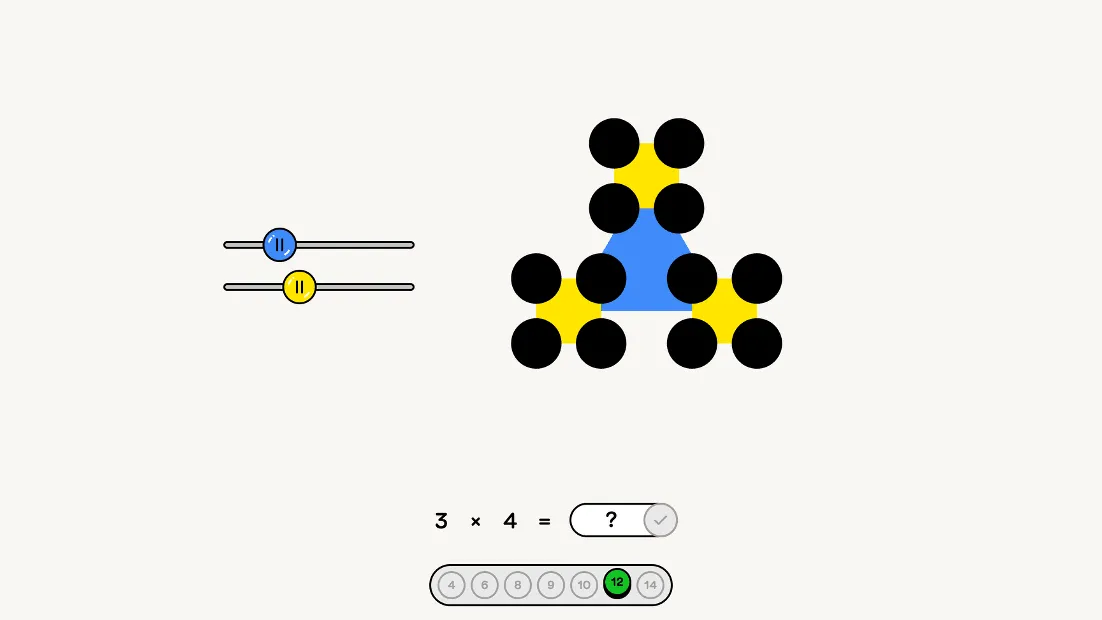
They're all looking at the same mathematics, but they're making sense of it in different ways– all of which are valid.
Research has consistently shown that students build deeper conceptual understanding when they connect visual models, quantities, and symbols⁽²⁾⁽⁵⁾, especially before direct instruction⁽⁶⁾.
If you already use math stations, this is a natural place to introduce a Struggly task. Students explore, talk with a partner, and come back together ready to share what they discovered.
Let students experience the power of "yet"
I saw this kind of learned helplessness all the time in my classroom. Students were reluctant to approach a challenging problem unless they had been given the exact steps to follow. It always broke my heart because it's such an unempowered way to experience mathematics—and the exact opposite of what I wanted for my students.
I came to realize those moments were some of the most powerful opportunities to talk about the power of yet. It's okay not to know how to do something...yet. In fact, I would encourage students to say it out loud: I don't know how to do this...yet.
That's why I love tasks like Sum Fishing. Students often think they've solved the puzzle, only to realize one number doesn't work (see example). That moment can feel frustrating, but it's also where the real learning begins. Students step back, rethink their strategy, and try another approach.
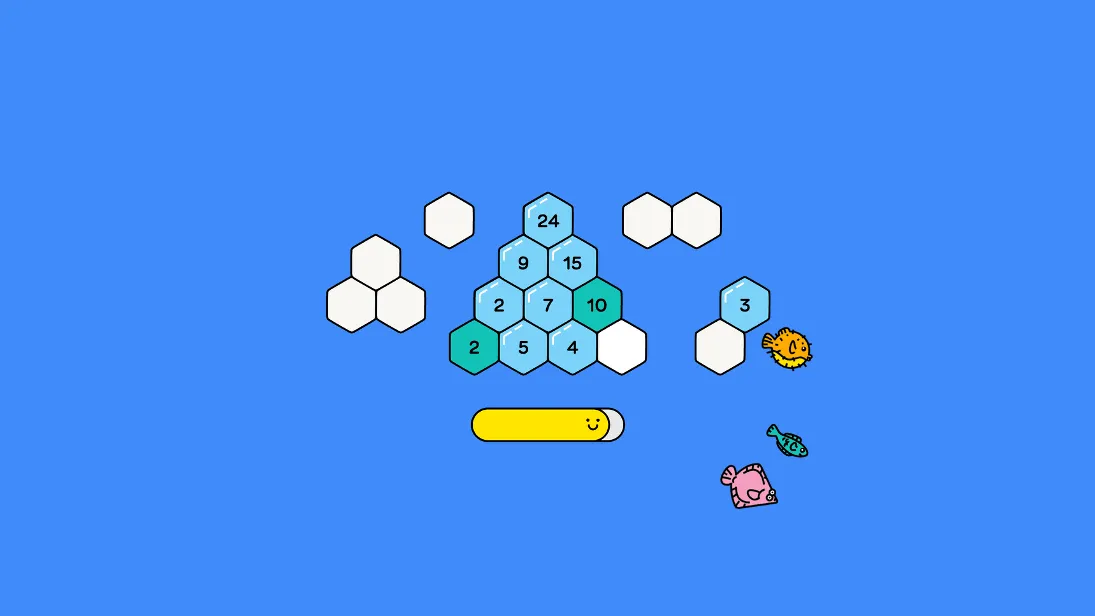
Over time, students begin to experience what yet actually feels like. They discover that being stuck isn't a sign they aren't a math person—it's often a sign they're doing the kind of thinking that leads to understanding.³
To help keep this message going strong in your classroom, we’ve created a free “Power of Yet” poster that you can download here to print and hang in your classroom. My suggestion is to point to it whenever students get stuck to remind them– if they don’t understand yet, they just need to keep at it!
Help students see themselves as math people
This year, don't just focus on what you want your students to learn. Think about how you want them to feel and who you want them to become.
A simple Notice & Wonder. A few minutes of visual exploration. A classroom where "I don't know...yet" is something to celebrate. Those small moments add up to something much bigger: students who see themselves as capable, curious, and confident math people.
Research
- Boaler, J. (2016). Mathematical Mindsets: Unleashing Students' Potential through Creative Math, Inspiring Messages and Innovative Teaching. San Francisco, CA: Jossey-Bass/Wiley.
- Park, J., & Brannon, E. M. (2013). "Training the approximate number system improves math proficiency." Psychological Science, 24(10), 2013–2019.
- Dweck, C. S. (2006). Mindset: The New Psychology of Success. New York: Random House.
- Fetter, A. (2011). "Ever Wonder What They'd Notice?" [Ignite talk]. National Council of Teachers of Mathematics.
- Boaler, J., Chen, L., Williams, C., & Cordero, M. (2016). Seeing as Understanding: The Importance of Visual Mathematics for our Brain and Learning. Journal of Applied & Computational Mathematics, 5(5), 1000325.
- Schwartz, D. L., & Bransford, J. D. (1998). A time for telling. Cognition and Instruction, 16(4), 475–522.